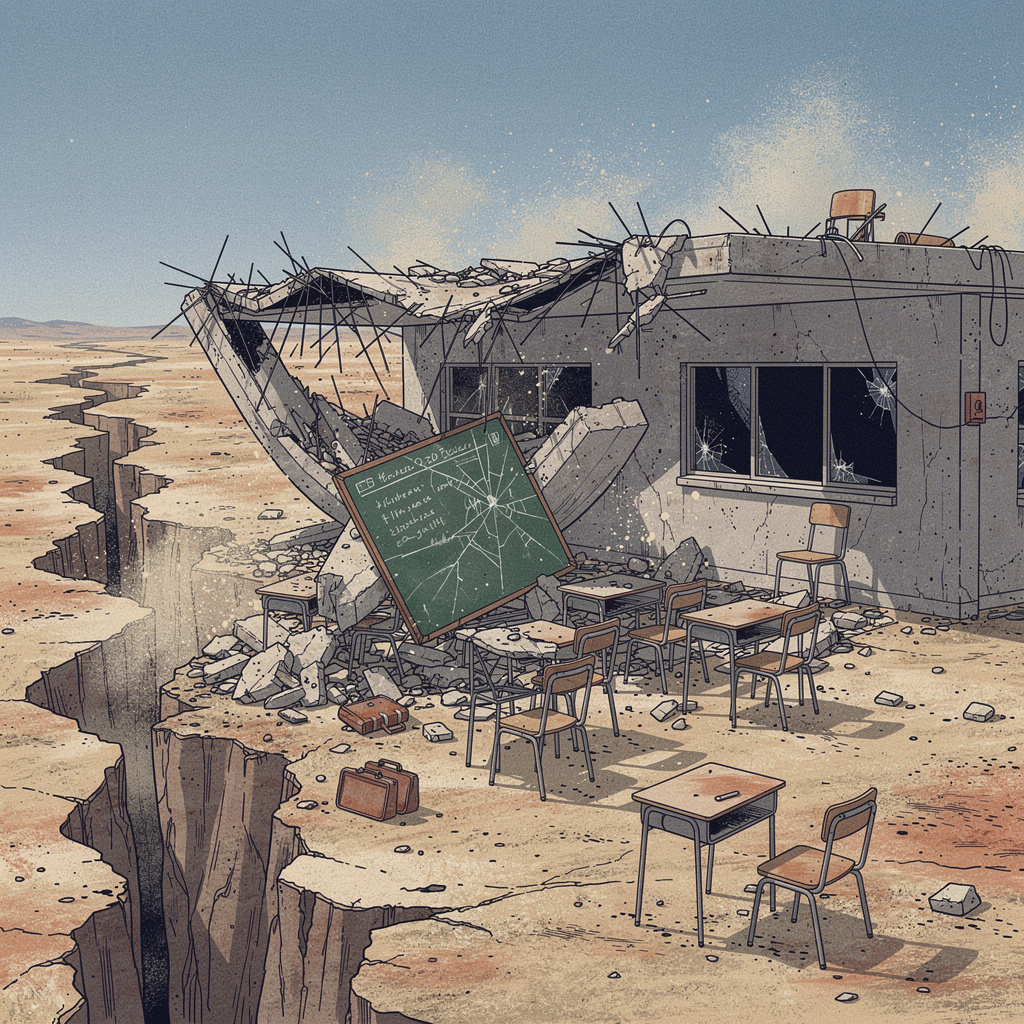

On 8th June a magnitude 7.8 earthquake tore through the seabed off Sarangani, sending tsunami warnings across half the Pacific and collapsing buildings from General Santos to Davao Occidental 4814212224. At least 41 are dead, over 20,000 displaced, and whole communities cut off by landslides 4512. The proximate cause is well understood: movement along the Cotabato Trench, the same subduction fault that produced the catastrophic 1970s Moro Gulf earthquake, which killed thousands 411. What remains stubbornly unclear is why, half a century later, the same geological threat continues to exact such a human toll.
“The Cotabato Trench killed thousands in the 1970s. Now it has claimed at least 41 more. The only variable is how many will die when it moves again.”
The Cotabato Trench is not an emerging risk. It is a known, recurrent hazard. The Moro Gulf event—magnitude 8.0, striking in 1976—generated a tsunami that inundated coastal Mindanao and killed an estimated 5,000 to 8,000 people. Phivolcs has long identified the trench as a principal seismic zone. Yet multiple outlets report that this week's quake is being described as one of the most destructive to hit the Philippines in five decades 411—a framing that betrays how little has been internalised from the earlier disaster. Hospitals now operate outdoors because the buildings cannot be trusted 5. Schools and critical infrastructure lie damaged 15. The power grid is down across swathes of the island, with the Department of Energy scrambling to restore supply 119. These are not the hallmarks of preparedness.
The immediate response has followed the familiar script. According to the DSWD, 1,200 households in Maasim alone have received emergency aid 23. Governor Tamayo has suspended classes and work across Sarangani province; General Santos declared a state of calamity 791626282930. Tsunami warnings were issued, then cancelled 2225. But crisis management is not the same as risk mitigation. The question is not whether agencies can mobilise after the fact—clearly they can—but why the same fault corridor remains so lightly defended.
Part of the answer lies in the economics of disaster. Mindanao is poorer than Luzon, its building codes less rigorously enforced, its infrastructure older. Retrofitting takes money and political will; both are easier to muster in Manila than in provincial Cotabato. But there is also a failure of institutional memory. The 1976 tsunami receded from national consciousness decades ago. The generation now building hospitals and schools in Sarangani did not live through it. The trench, meanwhile, does not care about calendars. Subduction zones operate on century-long cycles; the gap between 1976 and 2026 is geologically trivial.
The Philippines sits on the Pacific Ring of Fire and has no shortage of earthquake experience. Yet it treats each event as episodic rather than systematic. Japan, by contrast, has made seismic resilience a matter of infrastructure doctrine, precisely because it knows the next quake is not a question of if but when. Mindanao deserves the same logic. The Cotabato Trench will move again. The only variable is how many will die when it does.